
Gloves
EN 388 explained: what do the numbers mean?
· 4 min read · Hardpoint Safety
A work glove often carries a code such as 3X33D on the cuff.
That code belongs to European Standard (EN) 388. Once you can read it, you can compare gloves in a minute.
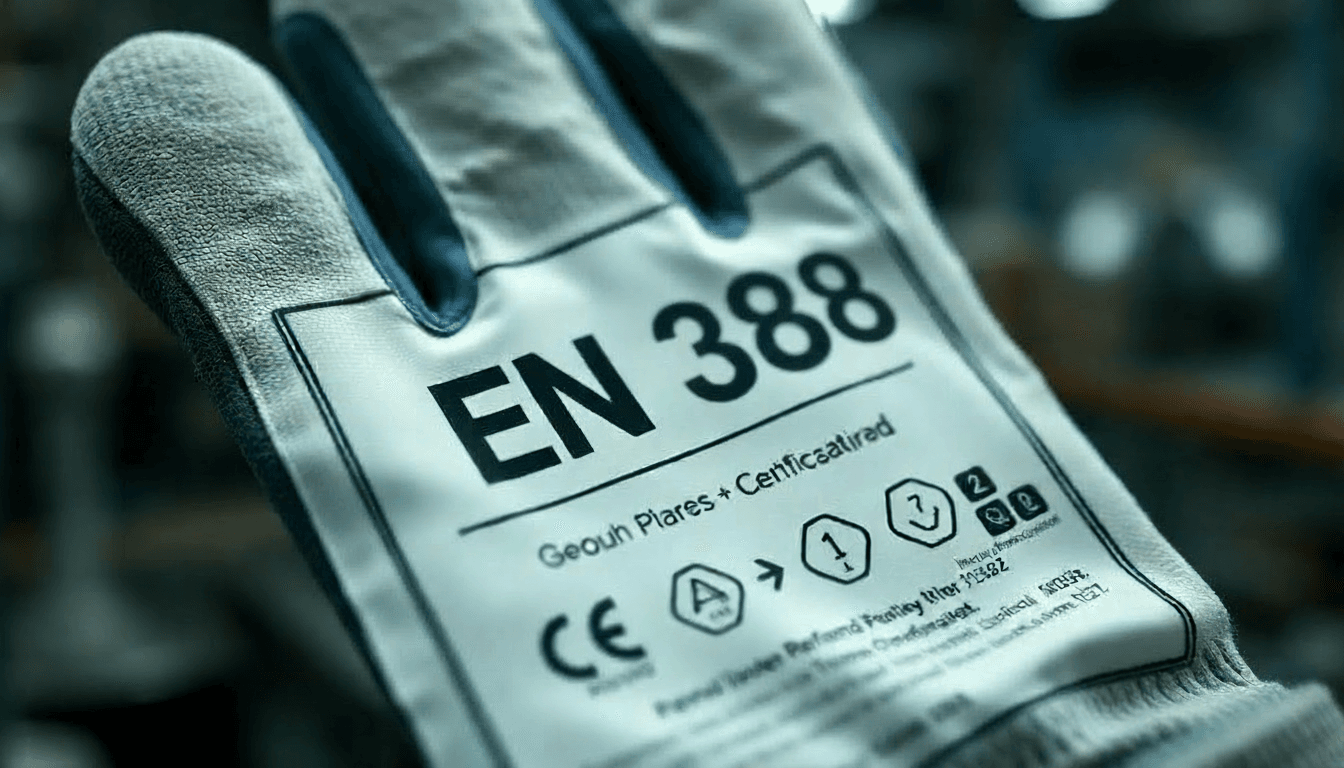
The photo on this guide is a close-up of a label. The small text in that photo is not readable. Use the code on your own glove, or the code on the product page.
In short
- The code has six places. Four digits, then a letter, sometimes a P.
- The letter is the cut protection. A is the lowest. F is the highest.
- An X means not tested.
- A P means the impact test was passed.
The six marks
- Abrasion, from 1 to 4. How well the palm stands up to rubbing.
- Cutting with the old blade test, from 1 to 5.
- Tearing, from 1 to 4.
- Puncture, from 1 to 4.
- Cutting with a tomodynamometer (TDM), a letter from A to F.
- Impact protection. A P when the test was passed. No mark when the test was not done.
The TDM test is also called ISO 13997. ISO is the international organisation for standards.
Abrasion
The first digit is the number of rub cycles the glove at least reaches.
| Digit | Cycles |
|---|---|
| 1 | 100 |
| 2 | 500 |
| 3 | 2000 |
| 4 | 8000 |
A 4 lasts longer on abrasive work than a 1.
Tear and puncture
Tear, the third digit, is in newtons. A newton is the unit of force.
| Digit | At least |
|---|---|
| 1 | 10 newtons |
| 2 | 25 newtons |
| 3 | 50 newtons |
| 4 | 75 newtons |
Puncture, the fourth digit, is also a minimum in newtons.
| Digit | At least |
|---|---|
| 1 | 20 newtons |
| 2 | 60 newtons |
| 3 | 100 newtons |
| 4 | 150 newtons |
The letter
The letter is the newer cut test. It is the one that counts with modern cut fibres, because the old blade test blunts the blade. The second place then shows an X.
| Letter | Force |
|---|---|
| A | at least 2 newtons |
| B | at least 5 newtons |
| C | at least 10 newtons |
| D | at least 15 newtons |
| E | at least 22 newtons |
| F | at least 30 newtons |
Three codes from the shop
The Granberg cut-resistant assembly gloves HP-WH-016 have the code 3X33D.
- 3: abrasion, at least 2000 cycles.
- X: the old blade test was not done.
- 3: tear, at least 50 newtons.
- 3: puncture, at least 100 newtons.
- D: cut, at least 15 newtons.
No P. This glove was not tested for impact. It is level D, with grip on dry and wet material. Made for offshore work, rebar and sawmill work.
The Granberg nitrile gloves HP-WH-006 have the code 4X43CP.
- 4: abrasion, at least 8000 cycles.
- X: the old blade test was not done.
- 4: tear, at least 75 newtons.
- 3: puncture, at least 100 newtons.
- C: cut, at least 10 newtons.
- P: the impact test was passed.
Level C is less cut protection than D. The P and the high abrasion make this model suited to shipping and oil and gas work, where knocks also happen.
The Granberg heavy duty glove HP-WH-009 has the code 3X44FP.
The F is at least 30 newtons. The P means the impact test was passed. Grip on dry, wet and oily material.
More examples of the letter are in choosing cut-resistant gloves.
Common questions
Is a higher digit always better?
For that one risk, yes. A glove with a 4 for abrasion can still have a low letter for cutting. Look at the risk that belongs to your job.
What if I only see 4543, with no letter?
Then the newer cut test is not shown. Ask for the letter, or choose a model that prints the letter on the product page.
Does EN 388 also cover cold and chemicals?
No. Cold is in EN 511. Chemicals are in EN ISO 374. EN 388 covers rubbing, cutting, tearing, puncture and impact.